
Bridging the $65B Automation Gap: How Robotics-as-a-Service (RaaS) Is Transforming Construction
How Robotics-as-a-Service is finally bringing automation to construction - and how we’re building it at Flo Mobility
A few years ago, if you wanted a robot on your construction site, you had only one choice: buy it. You would write a big check, wait months for delivery, hire someone to maintain it, and hope it didn’t sit unused as soon as your project ended. For most builders, that didn’t add up. Robots remained in trade show demos and factory floors, while everyone else moved materials the same way they always had—by hand, by truck, and through hard work.
That’s changing, thanks to a simple shift in how robotics is sold. They are now available not only as products to own, but also as services to use. We’ve built our entire business around this shift. Here’s the scale of what’s at stake. Construction employs over 270 million people worldwide, yet the industry uses only 15 to 20 robots for every 10,000 workers—compared to over 600 per 10,000 in automotive manufacturing.
This gap in automation represents a business opportunity worth around $65 billion. We believe robotics as a service (RaaS) will finally narrow this gap, and the growing demand for RaaS in logistics, healthcare, and now construction supports this idea.
What Is Robotics-as-a-Service, Exactly?
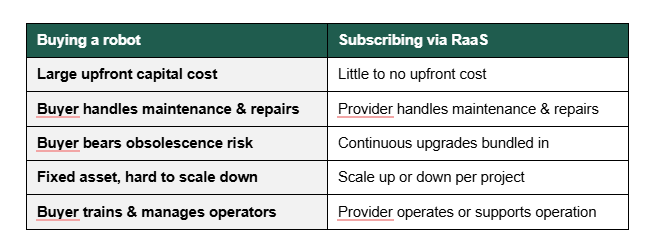
Robotics-as-a-service (RaaS) is a subscription approach for robotics. Instead of buying a machine, a firm pays a monthly charge to utilize a machine, and the provider owns and takes care of maintenance, software updates and support. Same thinking that revolutionized software 20 years ago, now being applied to physical hardware.
The underlying change is simple but powerful: RaaS, as a robotics as a service business model, changes robotics from a capital expense (CapEx), which means a big purchase up front and continuous upkeep, to an operating expense (OpEx), a predictable monthly or per-project cost. It also removes the overhead cost of the robot as a service — maintenance teams, spare parts, software licensing, downtime management — from the customer’s books altogether and rolls it into the provider’s price.
Once you start looking, examples of robotics as a service are everywhere: autonomous forklifts rented by the pallet in warehouses, subscription-based disinfection robots in hospitals, floor-cleaning robots leased to malls and airports – and on the job sites we work with every day, autonomous material haulers subscribed to rather than purchased.
Robotics Just Took Its Time Catching Up
You’ve been through this shift before. Businesses used to buy servers and install software on each workstation, then SaaS came along and you just logged in and paid monthly. The same rationale would be applied later to infrastructure, storage and payroll. Eventually anything expensive and hard to maintain would be easier to subscribe to than to own.
Robotics was the obvious next choice. Warehousing was the leader – certain AMR suppliers, like as Locus Robotics, incorporated RaaS into their whole operation from day one. Much of this is running on what is often called the internet of intelligent things and robot as a service architecture: connected, cloud-monitored machines that allow a robotics as a service company like ours to track battery health, push updates and reroute fleets across many client sites without sending an engineer to each one.
The Robotics as a Service Market Size, in Numbers
Analysts don’t agree on exactly how big the robots as a service market is, partly because “RaaS” gets defined narrowly (industrial mobile robots only) or broadly (any subscription-based robotics). But the direction is unambiguous:
Estimates for the robotics as a service market size range from roughly $2.2 billion (narrow definition) to over $30 billion (broad definition) as of 2025-26.
Nearly every major report projects 18-25% compound annual growth through the early 2030s.
Logistics and warehousing remain the largest adopters today, but healthcare and construction are singled out as the next big growth vectors — exactly where we’re focused.
Regardless of methodology, one thing is consistent: this isn’t a niche experiment anymore — it’s one of the fastest-scaling business models in industrial tech.
So Why Did Construction Take So Long?
Construction is hard, physically challenging - in a way that most contexts where robots have flourished are just not. The warehouse is a flat space with shelving set up and predictable arrangements. There is no such infrastructure on a building site: the ground changes weekly, there is muck and dust and rubble, and no established digital infrastructure to connect a robot into. Add in an industry based on manual labor paid daily, and it’s simple to see why robotics companies generally glanced at construction and turned away. A factory was easier to automate than a foundation. That is precisely the void we aimed to fill.
How We’re Doing RaaS at Flo Mobility
We started Flo Mobility in 2021 with a sense that there is a huge scope to automate logistics both in construction and industrial sites. Most material today is manually handled or moved by vehicles requiring human supervision and we saw a need to develop robots that could work on the ground level and carry loads of upto 1.5 tonnes on the horizontal plane and even vertically between floors.
This evolved into the development of our battery powered robot called Flo Hauler, most of which are currently deployed across multiple construction sites in India that use an automated, electric commercial vehicle to carry goods from one point to the other within a construction site or even between floors in a construction project.
The interesting thing has been that while we have seen that our product has had a demonstrable impact on the worksite in terms of reducing costs by about 45%, cutting material movement time by 50% and reducing workman injuries by up to 67%, the actual buying preference has been quite varied with some customers preferring to subscribe to the robot (we operate, maintain and provide the robot as a service to the customer on a monthly basis) while others want to outright buy the robot. What we feel is important is that we meet the customer where they are at instead of pushing one format over another.
As of our latest funding in May 2026, we have deployed over 60 machines across 25+ worksites spread across 10 Indian states with major builders such as L&T Construction, Godrej Properties, Embassy Group and Sobha among others using our robots on their projects with very positive feedback. Our robots have enabled these worksites to achieve the benefits enumerated above and some customers have even expanded their use case from one project to multiple projects with us which has been very exciting for us.
In May 2026, we raised $2.5 million pre-Series A round co-led by Mela Ventures and Arali Ventures, bringing our total funding to roughly $3.3 million in funding with plans to expand into the Middle East in the near future.
Why This Fits Construction - and What We’re Watching Closely
Construction sites are already RaaS (robots as a service) customers in a way; contractors rent cranes or scaffolding for the duration of a project, rather than buying equipment that will only see use intermittently. A robot subscription would integrate smoothly into that existing system, addressing the two issues that have made robots uninviting to this sector: environmental uncertainty, which we solve by engineering our solutions rather than leaving them to you, and the transience of a given site, which we address by ensuring that our subscriptions scale with the length of your project rather than its cost.
The benefits are clear: lower barriers to entry, reduced maintenance and upgrade costs, and demonstrable improvements to cost, time, and safety performance. But we are not naïve about the costs, which is why we invest so heavily in maintenance and support; a halted robot is a halted project, and downtime has far steeper costs to absorb in this sector. Similar considerations inform our approach to data security, insurance, and regulation, all of which remain pressing concerns in most jurisdictions for the time being, and which we tackle in partnership with our clients. Finally, while subscription costs inevitably accumulate to a larger sum than a purchase would have, we recognize that fact and offer a purchase option at the end of each contract year, so that you are not in any way locked into longer-term commitments than you are prepared to make.
The Road Ahead
What’s happening in construction is what happened to every industry that finally embraced “as-a-service” thinking: the technology was there for a while, but it was the business model that made it usable. Robots didn't have to get smarter to get to construction sites, the way they were sold and offered had to get smarter first.
There are 270 million construction workers around the world and a $65 billion automation gap that remains largely untapped. We believe we are just getting started. If your site is still moving material the way it did ten years ago, maybe you should ask yourself, do you want to own a robot or do you just need the work done?
Not sure if a subscription or one-time purchase is the right choice for your site? Chat with the Flo Mobility team and we’ll help you find the right fit. https://flomobility.com/contact