
From 48 Minutes to 14 Seconds: Fixing High-Rise Construction Hoist Delays
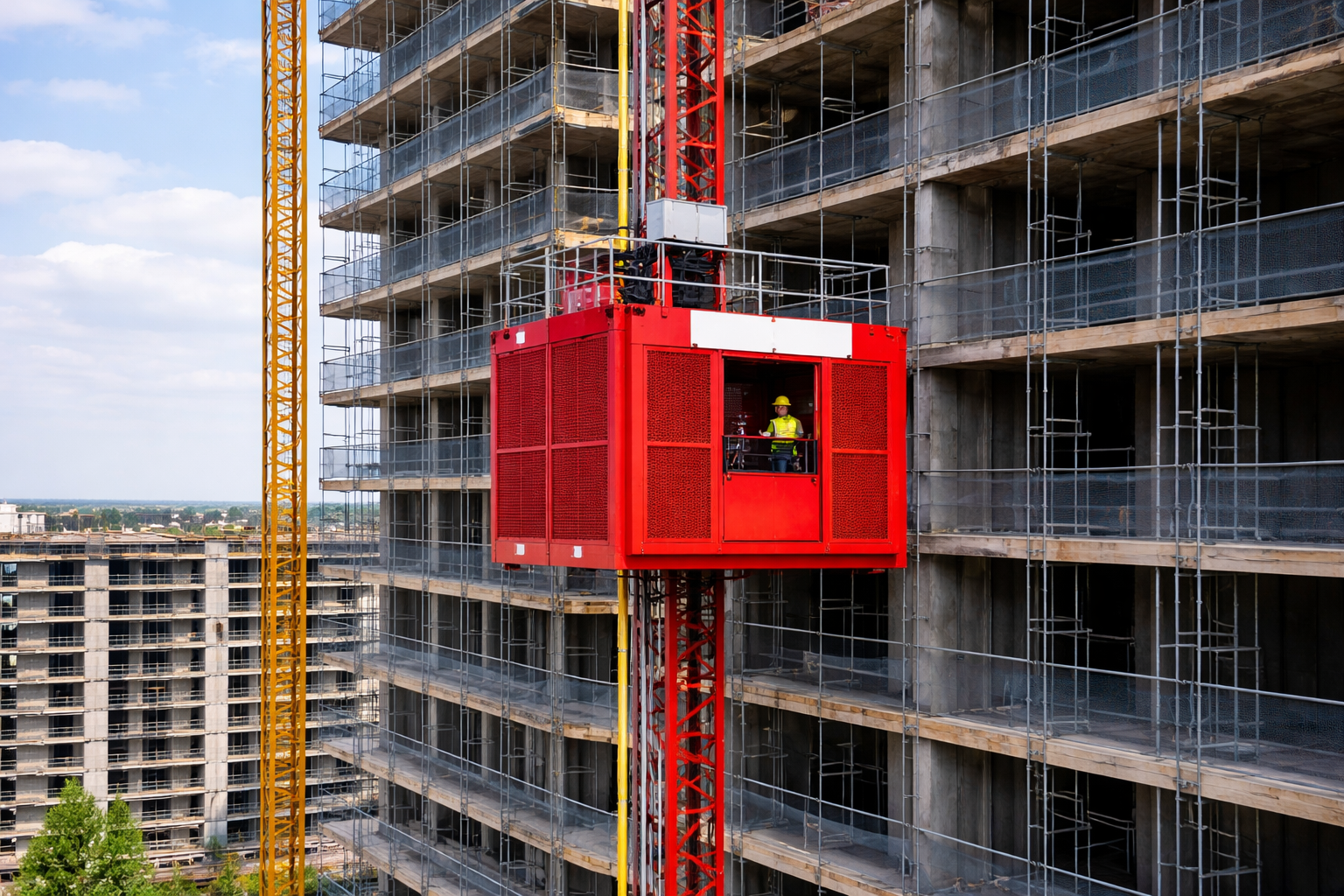
A construction hoist can travel hundreds of floors in a day. But how much of that time is actually spent moving? We went to high-rise construction sites in Bengaluru and Hyderabad to find out.
Walk onto a high-rise construction site and you will see a familiar rhythm. A hoist arrives at the ground floor, workers load material into the cage, it travels to an upper floor, another team unloads the material, and the cage returns for the next load.
It looks efficient from a distance.
But look closer and there is a surprising amount of time spent waiting.
A worker waits for the hoist. A loading crew waits for the cage to return. The hoist waits while material is unloaded. Another trade waits for its turn.
At Flo Mobility, we kept seeing this pattern across commercial and residential construction sites. So instead of estimating the problem, we measured it.
Watch the Case Study
We tracked material movement across high-rise construction sites to understand where hoist time actually goes-and what changes when autonomous material movement is introduced.
One Material Trip Takes 35–48 Minutes. But How Much Is Actually Movement?
Let's follow a typical material trip.
A load is prepared at the ground floor. The crew waits for the construction hoist, loads the material and sends it to an active floor. At the destination, another team needs to be ready to receive the load, unload it and clear the cage before the hoist can return.
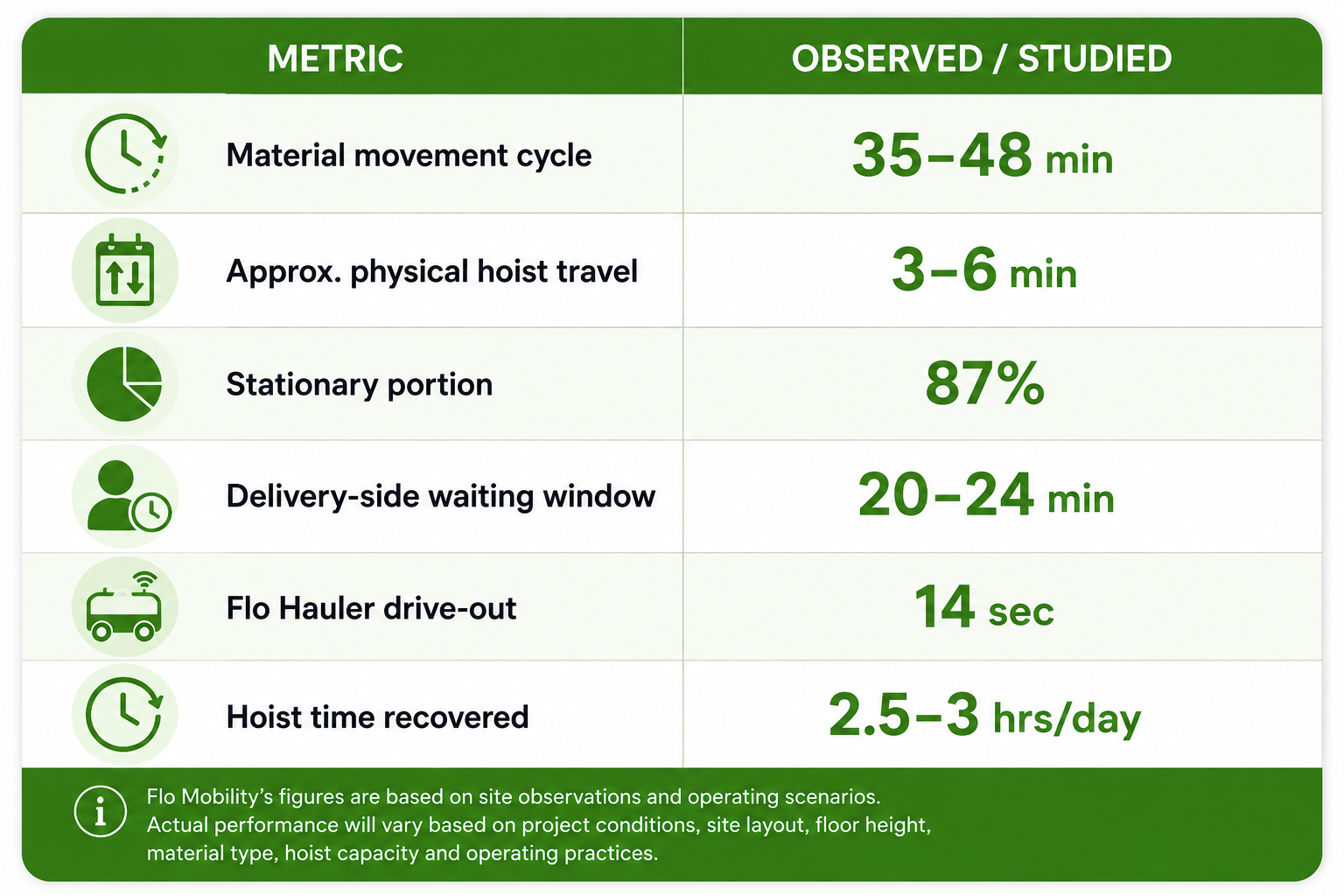
Across the sites we observed, a representative material movement cycle took approximately 35–48 minutes door to door.
But the actual vertical travel was only a small part of that time—approximately 3–6 minutes, depending on the floor and operating conditions.
The rest was spent loading, unloading, coordinating and waiting.
In one representative trip, that meant approximately:

The important distinction is that the hoist wasn't necessarily broken or unused. It was waiting for the process around it to finish.
Where Does All That Time Go?
At the delivery floor, someone has to receive the material. The landing area needs to be clear, workers need to unload the cage and the material needs to be moved away before the hoist can return.
In our observations, the delivery-side waiting window could be approximately 20–24 minutes, depending on site conditions and workflow.
At the same time, another team at the ground floor may already have the next load prepared.
They are waiting too.
This creates a chain of dependencies. The worker upstairs waits for the material, the crew downstairs waits for the hoist, and another trade may be waiting for its turn.
Nobody necessarily reports this as a project delay.
It simply becomes part of the workday.
And that is what makes this hidden cost so difficult to see.
The Human Cost of Material Movement
Consider a worker on the 20th floor who is ready to begin a task. The workspace is ready, the tools are available, but the material hasn't arrived yet.
For that worker, the next 20 minutes may not look like "downtime" on a report. But the task cannot move forward until the material does.
Downstairs, another worker may already have the next load prepared and is waiting for the hoist to return.
This is why material handling in construction is more than a logistics problem. It directly affects how effectively workers can use their time.
The issue isn't that people aren't working.
The issue is that the workflow isn't moving.
When 15 Loads Become 9–12 Hours of Hoist Demand
Now scale the same problem across a shift.
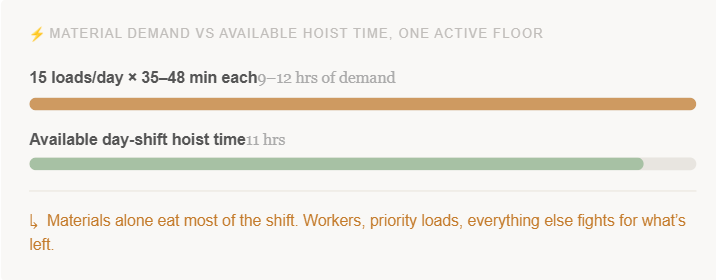
Suppose one active floor requires approximately 15 material loads per day. At 35–48 minutes per trip, that represents roughly 9–12 hours of hoist demand.
An approximately 11-hour day shift can therefore be heavily consumed by material movement alone.
And materials aren't the only thing competing for the construction hoist.
Workers need it. Tools need it. Priority loads need it. Other trades need it.
As buildings get taller and more floors become active, the demand on this shared resource increases.
The result is a familiar high-rise construction bottleneck:
More material → more trips → more waiting → less available hoist capacity.
So We Asked a Different Question
The obvious answer to a bottleneck is often to add more capacity.
But what if we could make the existing hoist available sooner?
Instead of trying to make the construction hoist itself faster, we looked at what happens around it.
One of the biggest opportunities was the movement that happens after the hoist reaches the destination floor.
Workers have to unload the material, move it away from the cage and clear the hoist before it can return.
That led to a simple question:
What if the material could leave the hoist by itself?
From Electric Wheelbarrow to Autonomous Material Movement
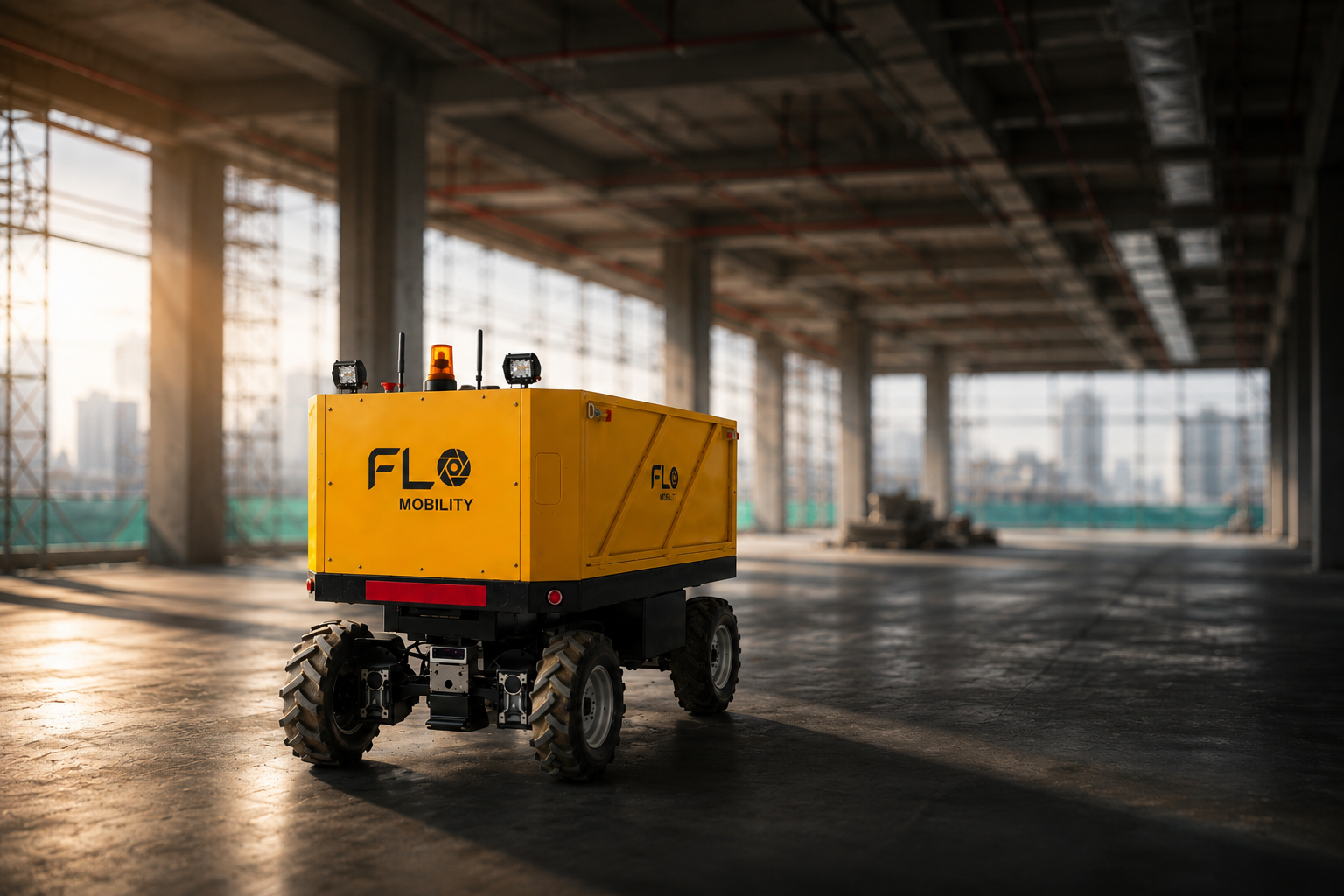
An electric wheelbarrow can reduce the physical effort required to transport material around a construction site.
An autonomous electric wheelbarrow takes this further by allowing the machine to handle repetitive horizontal material movement with minimal manual intervention.
The idea is simple:
The hoist moves vertically.
The robot moves horizontally.
Instead of keeping the hoist occupied while workers manually move material away from the cage, the autonomous material movement robot can take over the next part of the journey.
This is the approach behind Flo Hauler.
The objective isn't to replace the construction hoist.
It's to reduce the reasons it has to wait.
What Changes With Flo Hauler?
When used within a hoist-based material movement workflow, Flo Hauler can enter the construction hoist with the material and travel to the required floor.
Once the cage reaches the destination, the robot can drive out and continue towards the delivery point.
In our observed workflow:
14 seconds
Robot drive-out at the delivery floor
Instead of waiting for a manual crew to unload and clear the material, the robot can leave the cage and begin its next movement.
That means the hoist can become available sooner for its next trip.
And because the hoist is a shared resource, that recovered time can potentially serve another material load, another trade or another site activity.
Small Seconds Can Become Hours
Fourteen seconds may not sound significant on one trip.
But construction is repetitive. The same movement can happen 15, 20 or more times throughout a shift, across different floors and different trades.
Across the operating scenarios we studied, reducing waiting and unloading time at both ends resulted in approximately:
2.5–3 hours
of hoist time recovered per day
This is an observed outcome from Flo Mobility's operating scenarios, not a universal benchmark. Actual results depend on floor height, material type, hoist capacity, site layout, number of trips and operating practices.
But the underlying principle is important:
You don't always need more infrastructure to create more capacity. Sometimes, you need less waiting.
Why This Matters for Construction Workers
Construction automation is often framed around replacing manual tasks. We see it differently.
Workers spend their time doing skilled work that requires experience, judgement and coordination. Repeatedly transporting materials across a site does not always require those same skills.
An autonomous electric wheelbarrow can take on part of that repetitive movement, allowing workers to focus on installation, finishing, supervision and other tasks where their expertise matters most.
The robot moves the material. The worker moves the project forward.
That is where we believe construction robotics can create practical value.
The Bigger Problem Is the Waiting
High-rise construction doesn't necessarily lose productivity in large, obvious events.
It loses it in the gaps.
A worker waits for material.
The material waits for the hoist.
The hoist waits for unloading.
A loading crew waits for the cage to return.
Another trade waits for its turn.
One delay may not look significant. But multiply those moments across multiple floors, workers and material trips, and the impact becomes much harder to ignore.
This is why we believe the future of construction site automation isn't only about automating complex construction tasks.
It is about creating workflows where people, equipment and materials spend less time waiting for one another.
What We Learned From Measuring the Hoist
The biggest lesson wasn't that construction hoists are inefficient.
It was that even good equipment can become inefficient when the workflow around it remains manual.
The hoist is very good at moving material vertically. The opportunity lies in making the transition before and after that movement more efficient.
An autonomous electric wheelbarrow can become part of that system: taking over repetitive horizontal transportation, reducing manual handling and helping release the hoist sooner.
The hoist moves the material up.
The robot takes it from there.
The worker gets back to the job.
And the site keeps moving.
The Numbers at a Glance
 Is Your Hoist Spending Too Much Time Waiting?
If your project is experiencing construction hoist congestion, material movement delays or excessive manual transportation, the first step is to measure the workflow.
How many material trips happen every day? How long does each cycle take? How much time does the hoist actually spend travelling-and how much is spent waiting, loading and unloading?
At Flo Mobility, we are building autonomous material movement solutions for construction to help teams reduce repetitive material handling and make better use of the infrastructure they already have.
Because sometimes, the fastest way to make a construction site more productive isn't to make everything move faster. It's to make sure nothing has to wait unnecessarily.
Connect with us now at https://flomobility.com/contact